
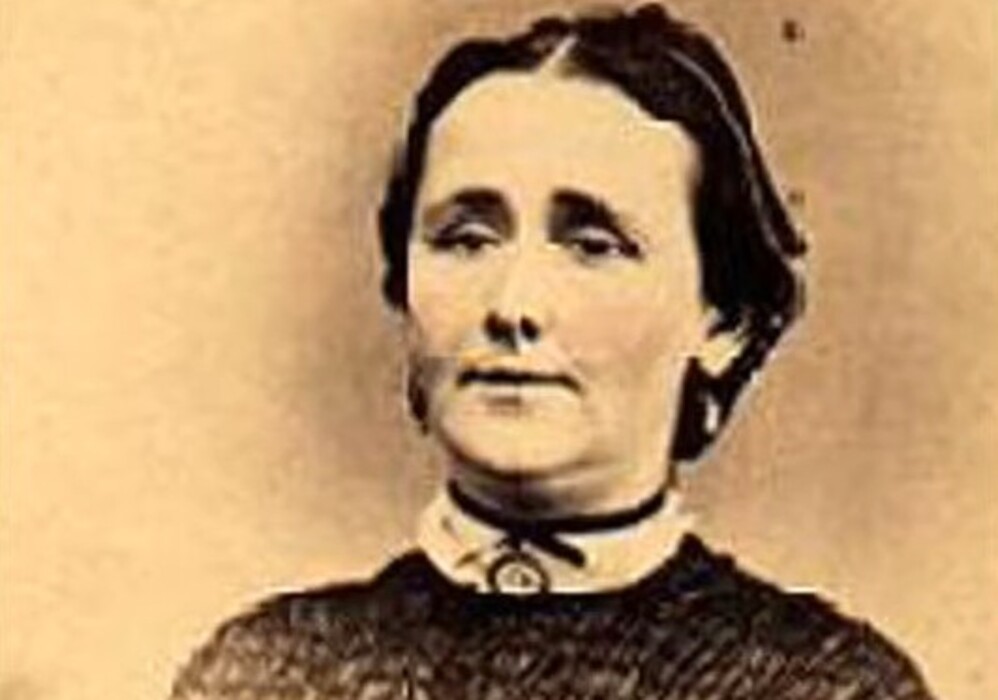

Margaret Catherine Moore Barry. Courtesy of US Patriot Flags
Sometime on the evening of Jan. 15, 1781, Margaret Catherine Moore Barry pulled on her coat and got ready to ride off through the woods and countryside near her home in Roebuck, S.C.
The night was wintry cold and dangerous for riding, and Barry would normally have been asleep beside her newborn who was less than three months old.
But this night was different. Barry was a scout and messenger for Revolutionary War General Daniel Morgan, who was encamped about 20 miles away along the Pacolet River at a place called Grindal Shoals.
Morgan’s troops were rumored to outnumber a pursuing British force 2-to-1, but no one really knew how many soldiers he had. Even if the rumor was true, Barry remembered that five months earlier, stronger American troops had been soundly defeated at the Battle of Camden only 100 miles away.
And she had learned that the pursuing British were much closer than Morgan knew: another British victory now could sway the course of the war in the south.
Barry had only a brief moment to get word to the general and to as many of the area’s standing militia as she could to join Morgan’s ranks against the British who would be here before dawn. Her horse was ready and waiting…
But there was a problem: She couldn’t take her newborn along.
Unless secured to a bedpost, the infant might crawl away and get hurt. And even though wrapped warmly, Barry knew the baby could still succumb to the cold if left alone. Leaving a fire in the fireplace might work for a few hours…but what if a hot ember escaped and burned the home? Or what if something happened to her along the way? No one would know her baby was there with no help – and even if nothing did happen to her, she might be gone all night and there was every chance that the newborn would not survive such a long time on its own.
The general needed her, and her baby needed her… Which sacrifice was she going to make?
If you live anywhere within breathing distance of Cowpens, chances are you know the rest of Barry’s story: She indeed got word of the advancing British to General Morgan, who withdrew 25 miles north to a place then known as Hannah’s Cowpens. Her ride lasted most of the night and took her miles from her home and newborn. And along the way, she rounded up every available militiaman she could find and sent them to reinforce the general’s ranks.
Because of her action at a critical moment, Morgan’s forces were in a much better position to fight: shortly after dawn the next day, January 17, the Americans decisively routed the British – a victory that not only stood on its own merits, but eventually played a part in the full British surrender later that year.
“We have no way of knowing how many patriots came to fight at Cowpens due to Kate Barry’s ride,” said Alice Caskey, State Regent for the Daughters of the American Revolution. “But we do know that those who did show up won the battle which resulted in Kate Barry becoming a heroine.”
And in case you’re wondering, her baby survived. But 245 years later, the legend and the question still lingers: Did Barry really tie her newborn to a bedpost and leave the baby alone as the legend claims?
The only reference seems to come from a 1963 poem by Spartanburg Poet Laureate Harry Russell Wilkins, in which he wrote:
“While tying “Baby Kate” to the bedpost, fond,
Brave mother Kate kissed her again, and said:
“I must be on my way to spread the news
From farm to farm, from house to house, ere dawn!”
But Barry’s newborn at the time was actually a son, whom she named Richard.
In another part of the poem, Wilkins calls Barry’s horse ‘Dolly’, although no record of the horse’s name seems to exist.
And although Barry had four other children at the time who were ages 2-8, somehow none of them seemed to be around when the ride happened.
Plus, the actual number of Morgan’s troops still remains disputed: American Battlefield Trust puts the total at 1,065 – less than the British forces.
Writer historian Lawrence Babits in his 1998 book, ‘A Devil of a Whipping: The Battle of Cowpens,’ estimated the total at 2,000, reinforced by militia.
Morgan, at the time of the battle, claimed to have only 800, a figure supported by writer historian John Buchanan in his book ‘The road to Guilford Courthouse’ in which he says, “Let us leave it that he had between 800 and 1,000, for a true count will never be known.”
One fact, however, is clear: amidst the truth, the rumor, the varying battle troop estimates, and Wilkins’ poem, Margaret Catherine Barry not only helped a noted general win a crucial Revolutionary War battle, she is nationally recognized as a bona fide American heroine.
“We actually have part of Highway 29 from East Main St. to Cowpens that is named after her,” said Kristopher Chadwick, director of the Cowpens Depot Museum. “And if people come to the museum while I’m there, they end up knowing about Miss Barry.”