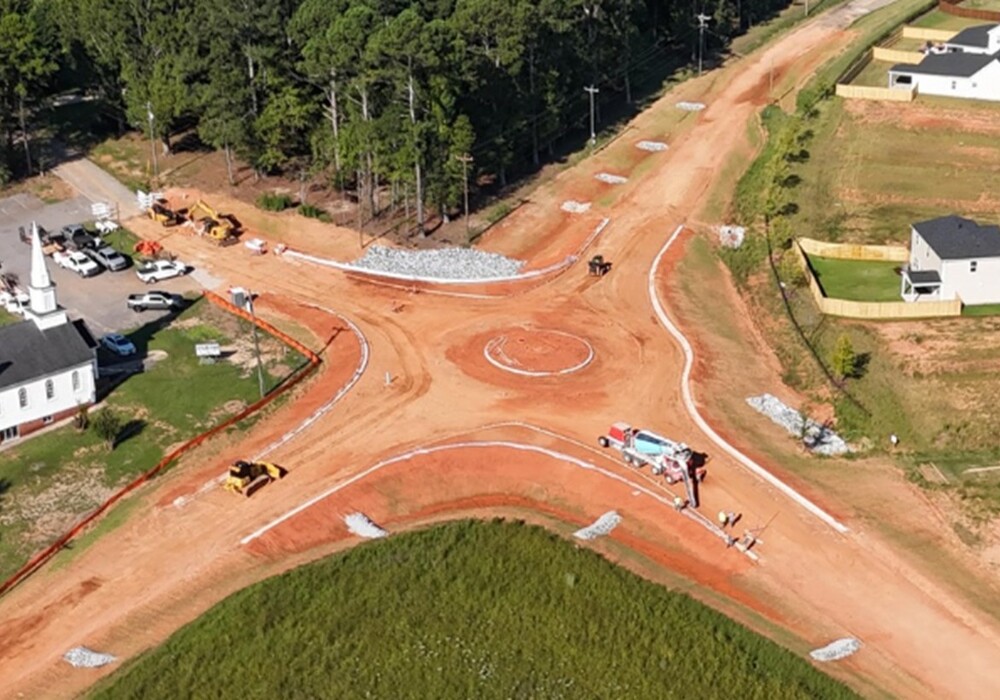

The roundabout intersection at Zion Hill and Sloan’s Grove Road, totaling $1.4 million and funded by the Spartanburg Penny Project, is currently on schedule to be completed by mid-October. Photo courtesy of Spartanburg Penny Project.
When Spartanburg residents approved a referendum in November 2023 for a penny sales tax to fund road, bridge, and other county infrastructure improvements, no one knew for certain if the measure would do anything other than separate taxpayers from even more of their money.
But in the three years since its acceptance, this effort, known as the Spartanburg Penny Project, is not only making for many safer roads and bridges, but serving as a model for how much tax dollars can accomplish when used for the right reasons.
“As of April 2026, at least 21 of the 577 projects have been completed, representing approximately 18.08 miles of roadway resurfacing,” said Scottie Kay Blackwell, communications manager with Spartanburg County. “We currently anticipate approximately 146 projects will be completed in 2026 alone, as construction activity continues to accelerate across multiple tiers of roadway and subdivision reclamation work.”
The six-year program, slated to run through April 30, 2030, will raise an estimated $478 million to address deadly and unsafe intersections, improve pothole-filled corridors, and repave high-use roadways across the county.
Projects underway, completed, or scheduled for construction in 2026 include:
• Repaving of Highway 290, St. John’s St., and North Daniel Morgan Ave.
• Improvements to West Main Street in downtown Spartanburg.
• $250,000 for pavement markings and grooved rumble strips on road shoulders.
• Intersection improvements to Floyd Road at Cannon’s Campground Road, and Dogwood Club Road at Hwy. 176.
• $1.4 million for improvements to the roundabout intersection at Zion Hill and Sloan’s Grove Road.
“The Zion Hill intersection has needed the most attention so far,” said John Wade, county transportation engineer: “We’ve had more than 25 accidents there in a 5-year period, and the work there has completely altered this intersection.”
Projects for all 11 county municipalities other than the City of Spartanburg – such as Landrum, Campobello, Reidville, and Cowpens – will carry the same importance.
“Every one of these municipalities relies on us to manage their road construction projects,” Wade said. “So we’ve set the Penny up in such a way that they each get up to $1 million in funding for their roads.”
Spartanburg is one of 22 state counties authorized since 2019 for these kinds of capital projects tax improvements.
https://dor.sc.gov/sales-use-tax-index/local-sales-taxes
So far, 13 intersections are currently in design phase; 30 stormwater culverts will be replaced to improve safety and provide increased capacity; and 10 county-maintained bridges are also scheduled to be replaced.
All of which, however vitally needed, pales in comparison to the work needed on roads alone.
For example, measured on a scale of 0-100, the average condition of all county roadways before the Penny project began was 57.5.
That’s for all of Spartanburg County’s highways, neighborhood streets, corridors, and public connectors – which, if laid out in a straight line, would measure 1,830 miles and end on the outskirts of Winslow, Ariz., “about 60 miles short of Flagstaff,” Wade said.
And Blackwell pointed out that every penny raised in the program can only be applied to road repairs and similar efforts – none of which would be possible without the passage of the 2023 referendum because other funding sources would not have been able to reach the $35 million needed each year to maintain the county’s existing infrastructure.
“Prior to the Penny program, the former $25 Road Fee generated only about $7–$8 million annually, which was not sufficient to keep pace with maintenance needs, much less address deferred maintenance and growth demands,” Blackwell said. “The 1% sales tax provides a more stable, pay-as-you-go funding model that allows the County to systematically improve roads, bridges, and infrastructure without over-reliance on debt or placing a disproportionate burden on property taxpayers.”
Wade added that while money was also raised by utilizing three, $30 million bond issuances, it was not a sustainable as a long-term fundraising solution because “we have to pay it back, and because it was judged to be an illegal funding source, so that source went away.”
“So had we not passed the Penny tax, we would be in a much worse condition with our roads,” he said. “And we wouldn’t be able to so some of these public safety projects, such as Sloan’s Grove, and the stormwater and drainage, and the county corridors. There’s no other source that will allow us to do this.”