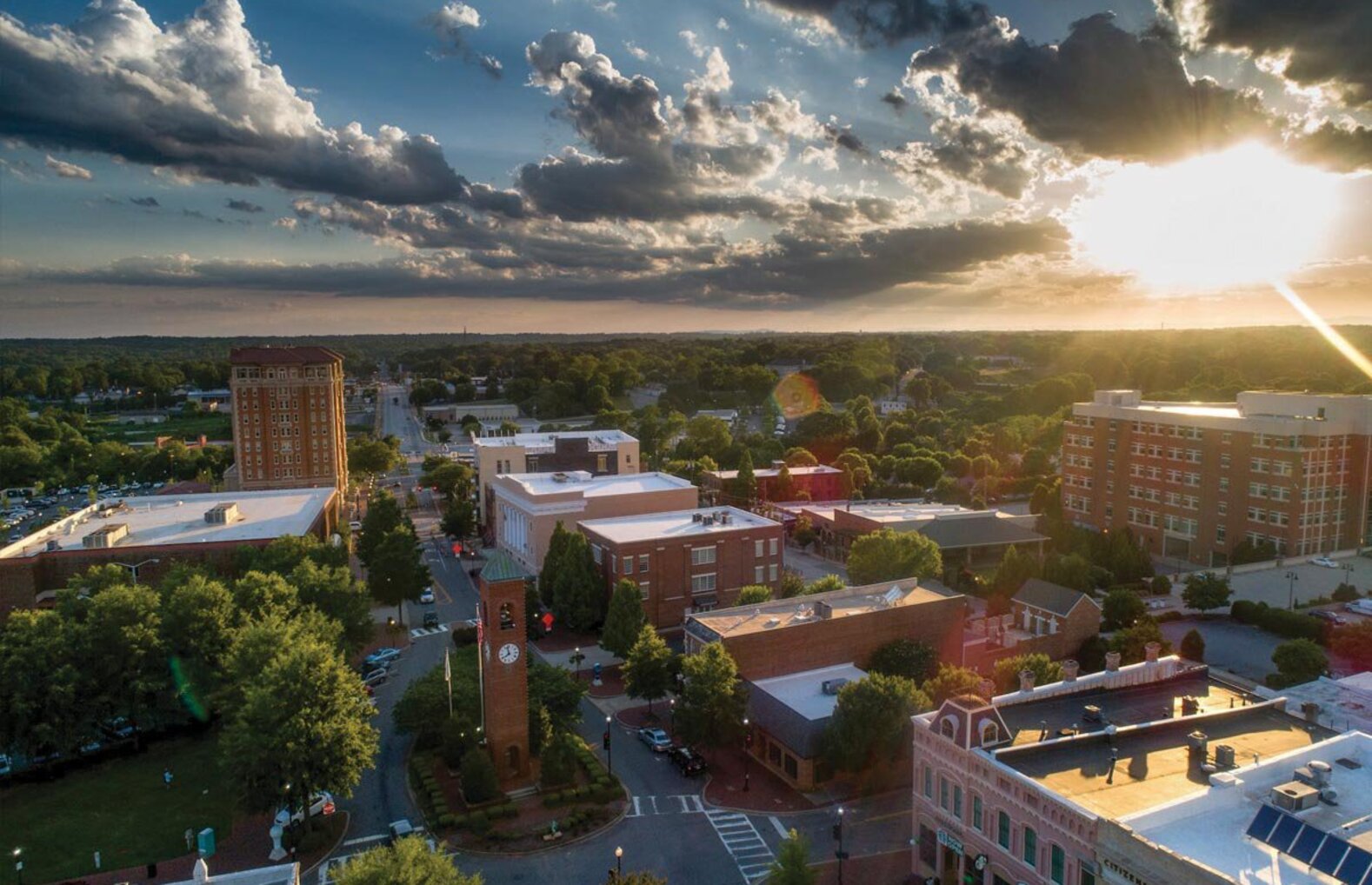
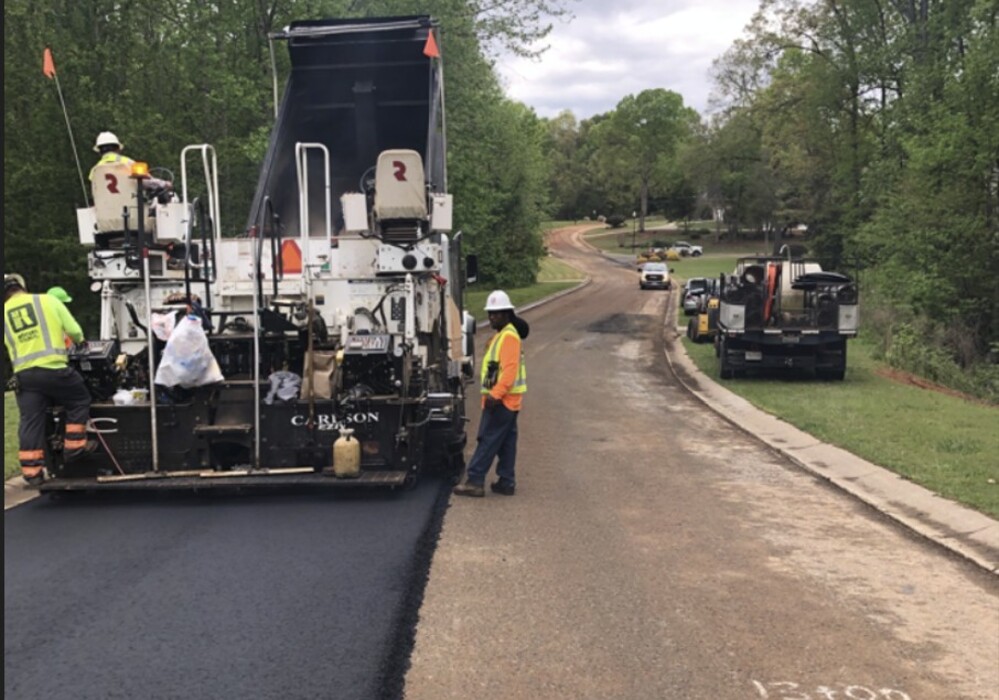

Road crews lay fresh asphalt during a Spartanburg County Capital Penny resurfacing project. The voter-approved program is funding hundreds of road and bridge improvements across the county, with more than 140 projects expected to be completed in 2026. Photo courtesy of Spartanburg County.
Residents of Londonderry Subdivision in Moore will soon see a lot of road crews laying down new asphalt to repave roads in their neighborhood.
The repaving in the 330-home neighborhood is part of Spartanburg County’s ongoing Capital Penny program begun in 2024 to fix all county roads and bridges by 2030.
And the program is not only working, but setting a high standard for all other South Carolina counties.
“To date, there have been eight penny projects completed, totaling 21.3 miles,” said county transportation engineer John Wade. “That includes preservation work, intersection improvements at Zion Hill and Sloan’s Grove Road, St. John’s and West Main streets, Daniel Morgan Avenue, and the Highway 290 package from the South Carolina Department of Transportation.”
The work at London-derry was scheduled to begin July 27. It is part of the county’s Tier 2 resurfacing effort, which is estimated at $76.38 million.
Another subdivision asphalt resurfacing will start in mid-August.
And of the program’s 577 total projects, which are all divided into six different tiers, approximately 146 are expected to be completed in 2026 alone – all due to resident voter approval in 2023 for a penny sales tax to fund road, bridge, and other county infrastructure improvements.
Wade pointed out that without the Penny program, county money would be able to fund only about $8 million in resurfacing, roughly one-third of all needed repairs throughout the county.
“But with the program we can do all $25 million of the resurfacing,” he said. “That’s 27 miles of resurfacing in just the first tier, and another 35 miles in Tier II. That’s unheard of from what we’ve done in the past, and impossible to do without the Penny program.”
It’s an idea that has caught on in many state communities.
So far, only six of the state’s 46 counties have not implemented either a Capital Projects Tax or a Local Option Sales & Use Tax.
Greenville, Anderson, and Oconee counties in the Upstate are three of them, and Greenville has a pending referendum this November for a 1% transportation penny sales tax.
In other areas, however, just like Spartanburg, many roads and connecting infrastructure are in need of critical attention.
Several of these projects involving DOT include:
• Safety improvements along a 1.8-mile section of Remount Road in Hanahan near Charleston. This corridor was on DOT’s statewide priority ranking, with specific concerns for vehicles, bicyclists, and pedestrians.
• A 3-month repair, rehabilitation, and preservation service effort for Kempson Bridge Road over Saluda River in Saluda County.
• DOT’s partnering with the Appalachian Council of Governments to reconfigure the existing intersection of U.S. 29 (Granard Street) and Floyd Baker Boulevard in the City of Gaffney.
• 18 bridges in Aiken, Bamberg, Kershaw, Lexington, Orangeburg, Richland, and Sumter counties, meaning that all 18 bridges have one or more components in poor condition.
And Wade added that Spartanburg County has its own issues with bridges: the work on Alverson Road bridge in Campo-bello, deemed as one of the worst, is scheduled to be bid on Sept. 10.
But if the past two years are any indication, Spartanburg is on pace to outpace all other penny programs in South Carolina.
When asked the biggest plus so far in fixing the county’s roads, Wade said even more than improved traffic journeys, fewer car repairs, and fewer accidents due to bad roads, it is recognition by DOT officials that “because of the penny program, Spartanburg will be the only county in the state where the primary road systems have been brought up to par by 2030.”
“It shows we’re ahead of the curve,” he said. “What we are doing should be example for others to look at and follow, but we have a long way to go. I have had individuals in other counties reach out to me to find out how they can implement a similar penny program.”
Not the least of which is the work ethic of the paving crews: So far, no Penny work has been slowed or halted due to summer heat – nor is it likely to.
“The folks in the paving industry are a tough group of individuals,” he said. “But we have to be mindful that our crews are supplied with enough water and work breaks in the shade to do what they can to cool off.”