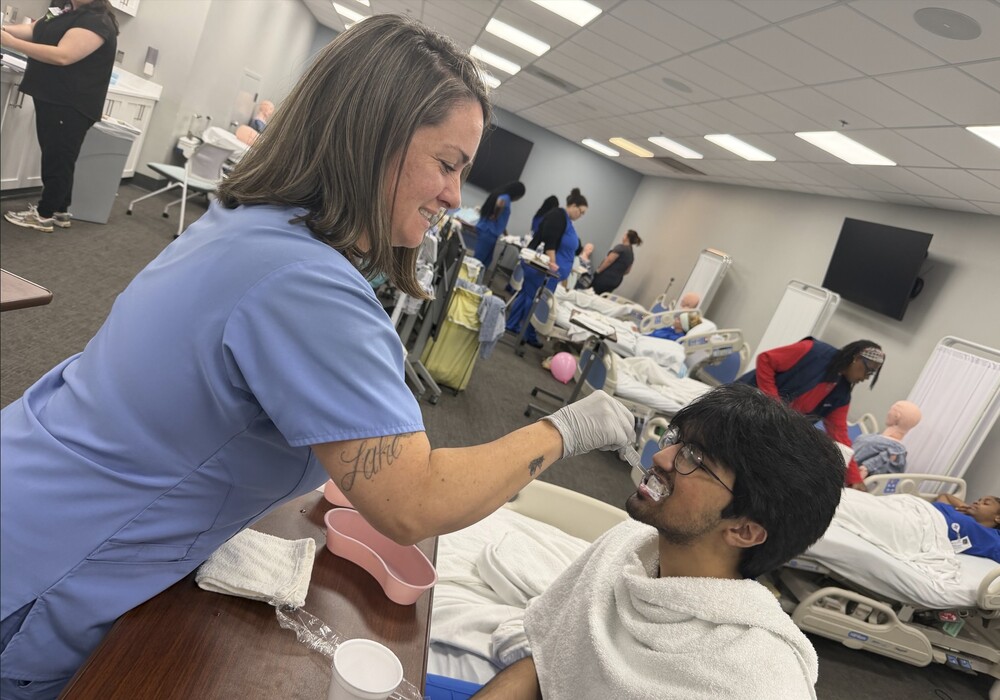

Misty Parnell gives Zain Jabbar a brush-up during June's Career Cohort Pipleine training. Photo courtesy Mia Kwiatkoski.
By the time she walked across the stage to receive her high school diploma, Mia Kwiatkoski of Inman in Spartanburg County already had her license to be a Certified Nursing Assistant (CNA).
This summer, however, Kwiatkoski intends to be on a much more important stage when she renews her CNA designation through a county-wide initiative known as the Certified Nursing Assistant Cohort Career Pipeline.
Piloted for the first three weeks this June with 32 participants, the pipeline offered instructor education and on-the-job experience for current employees with Spartanburg Regional Healthcare System (SRHS) seeking career advancement, and for Spartanburg County residents interested in healthcare careers.
Once they complete both their written and skills exams in July, Kwiatkoski and her new colleagues will not only be able to offer better health care for SRHS patients, but hopefully fill some critical gaps in a longstanding need for more healthcare professionals.
“Launching the CNA cohort was a collaborative effort that stemmed from Spartanburg County, much like many communities around the nation facing a growing demand for frontline healthcare workers,” said Karl Lamb, chief nursing and operating officer with Spartanburg Hospital for Restorative Care and Post-Acute Division. “The Post Acute Division is one of several areas that will benefit from this CNA cohort.”
For example, post-acute patients are often older adults who need short-term treatment to recover from severe injuries, illnesses, or urgent medical conditions. Post-acute is the opposite of chronic, longer-term care.
And this is where Kwiatkoski and the pipeline CNAs come in: to make someone’s healing faster, and as personal as possible.
“It’s the patient-first aspect that drives me,” said Kwiatkoski, who working in finance in another company when she found out about the pipeline and decided to get back into healthcare. “And you get to learn so much, which is good if you want to expand in the healthcare field.”
While her long-term aim is in the field of radiology, other pipeline participants – such as Donica Allen – are concentrating for the moment on the job at hand to see where it might lead.
“I have always liked helping people, but only have a year of experience, so this program will help me get more experience that I will need later on,” said Allen, originally from Jamaica, who was serving as a volunteer with SRHS when a manager notified her of the pipeline. “A lot of our patients are older, some reside in nursing homes, and they need someone to listen to and interact with them. And that’s the part I like best.”
The cohort pipeline was made possible by a partnership with SRHS, OneSpartanburg, Inc., and the Spartanburg Academic Movement (SAM).
“This pipeline is being supported through a grant opportunity from the Healthcare Anchor Network,” said City Councilwoman Meghan Smith, who also serves as SAM’s director for center of postsecondary success. “It is for $150,000 and will run through summer of 2027.”
Part of Allen’s and Kwiatkoski’s duties include helping patients eat, get dressed, brush their hair, monitor their vital signs, and provide comfort and emotional support, especially to those facing health challenges.
While all of this may sound like soft or luxury skills, Lamb indicated that the pipeline CNAs are meeting a crucial patient need that doesn’t show up on chart, a stat sheet, or a medicine bottle.
“This is about caring for our community – by investing in the people who care for our patients every day,” she said.
And in a 2025 article entitled “A Looming Disaster: The Certified Nursing Assistant Staffing Shortage,” for the National Institutes of Health (NIH) in Bethesda, Mary., emergency preparedness manager Austin Dobbs with the University of Georgia, said in part that the CNA staffing crisis in American long-term care facilities has reached “critical levels, jeopardizing the quality of care for residents and the well-being of staff.”
“As of July 2024, over 1.2 million Americans reside in one of the nation’s 14,827 certified nursing homes,” Dobbs said in his article. “CNAs…provide emotional support for residents by being a continuous visitor and company. Moreover, given their regular presence with residents, CNAs perform a vital role in the early detection of disease and other issues that other healthcare personnel may not perceive.”
Kwiatkoski and Allen also pointed out that their presence allows higher-level nurses to concentrate more on dispensing patient medication, inserting tubes, drawing blood, giving IVs, and advising doctors.
“We can’t do everything they do,” Kwiatkoski said. “But I love being there to support people in a personal way.”
And the demand for this kind of support is only going to increase on almost every health front:
In a 2025 report by the U.S. Census Bureau, researchers estimated the number of U.S. seniors at more than 61 million and counting – outnumbering children in 11 states and nearly half of all the nation’s counties.
NIH further estimates that by 2030, the U.S. will need an additional 2.3 million direct care workers.
And the Bureau is also projecting older adults to outnumber children by the year 2034 for the first time in U.S. history – meaning that SRHS may yet decide to employ more cohort pipelines in the future.
“A stronger CNA workforce helps reduce strain on our nurses, improve patient satisfaction, and strengthen the quality of care,” Lamb said. “This program addresses that need.”