
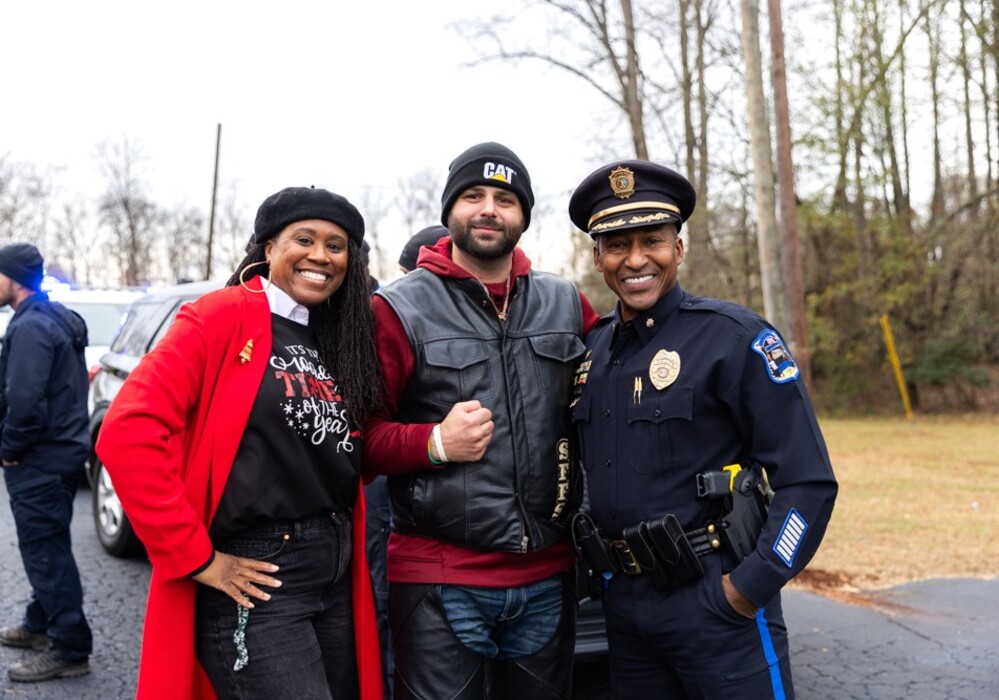

Project R.E.S.T. leader Krystal Watson, left; Michael Morrison, member of The Shop motorcycle club who organizes Project R.E.S.T.'s annual toy run; and Maj. Art Littlejohn of the Spartanburg Police Department are three supporters of a state bill to combat domestic violence. — Photo courtesy Project R.E.S.T.
People convicted of physical attack, sexual assault, and other abuse within a family or personal relationship could soon face a much harder road if a new domestic violence bill passes in the South Carolina State Legislature.
Introduced in the State House on January 14 by co-sponsors Rep. Sarita Edgerton, R–Spartanburg, District 34, and Rep. Melissa Lackey Oremus, R–Aiken, District 84, this bill is specifically intended to provide a statewide database of individuals convicted of committing two or more acts of criminal domestic violence.
The State Law Enforcement Division (SLED) would maintain the registry and make it publicly accessible online.
The registry would include offenders’ names, dates of birth, conviction dates, counties of convictions, and current photographs.
“It improves how existing laws protect victims and prevent repeat violence…and closes gaps that too often leave people unprotected,” Oremus said.
However, if the new bill were to pass both the House and state Senate in time to become law in the current legislative session, which ends May 14, it would apply only to individuals convicted on or after Jan. 1, 2027.
Otherwise, the bill would have to be re-filed next year – which Edgerton said would just further delay a point of justice that is far overdue.
“As a child, I was a victim of abuse from my stepfather,” she said. “And I watched my birth mother endure horrific abuse by this man.”
Oremus added, “Too many victims live in fear, unsure where to turn, worried they won’t be believed, or trapped in a system that doesn’t move fast enough to protect them.”
In the Upstate, one group of people pushing for the bill’s passage is Project R.E.S.T.
Founded in 1996 and located in downtown Spartanburg, Project R.E.S.T. (Restore, Empower, Support, Reform) now utilizes the support of about 125 volunteers to provide relief, shelter, and various forms of support for domestic and sexual assault survivors in Union, Cherokee, and Spartanburg counties.
Local attorney Krystal Watson, the group’s president/CEO since 2023, sees the new House bill not only as a vital step forward, but a measure that should have been enacted decades ago.
“This bill has the potential to help survivors feel safer by improving accountability for repeat offenders and ensuring patterns of violence are not overlooked,” Watson said. “Survivors of domestic violence and sexual assault face enormous barriers to safety and justice.”
For example, Pathways To Safety International, a 24/7 virtual crisis center serving thousands of Americans each year affected by domestic violence, sexual assault, and human trafficking in more than 100 countries, cites social fear, job support, danger in safety relocation, and reintegrating into society once victims have left an abusive relationship.
The Violence Policy Center in Washington, D.C., which advocates in part for stronger gun violence prevention laws and policies, lists South Carolina as one of 10 states with the highest rate of females murdered by males.
The South Carolina Coalition Against Domestic Violence and Sexual Assault further cites more than 30,000 cases of intimate partner violence reported annually. Which, economically, is estimated at an annual cost of $358 million, including lost productivity and system response costs.
And Watson pointed out that in 2025 in the Upstate, Project R.E.S.T. alone fielded 1,301 calls to its 24-hr crisis line, with another 371 individuals walking in for help and support.
A total of 70.5% of the survivors were from Spartanburg County.
“These numbers represent real people seeking safety, stability, and support – and underscore why comprehensive, survivor-centered services remain essential in our community,” Watson said. “My hope is that this bill helps disrupt the cycle of violence by strengthening accountability and earlier intervention. For many survivors, safety comes from knowing the system recognizes their experiences and takes repeated abuse seriously.”
And there is a personal note as well: When asked why she closed her own law practice in 2023 to support Project R.E.S.T. fulltime and fight for new domestic violence laws, Watson said it wasn’t so much a change of career as just focusing on one part it.
“I have spent years serving underserved communities – including low-income individuals, children, and the elderly,” she said. “Advocating for them has been the focus of my entire legal career. And it is an honor to expand that work through Project R.E.S.T.”